Vehicle Technology
Advancing vehicle technologies is central to reducing greenhouse gas emissions from transportation and addressing climate change in Oregon.
New vehicle technologies that can reduce greenhouse gas emissions fall into two buckets: Engine technologies that allow use of lower emission fuels, and technologies that improve fuel efficiency.
Engine technology and lower emission fuels
Internal combustion engines that run on gas and diesel are the most common types of engines found in today’s vehicles. However, over the last few decades, new engines were developed that can use new types of fuels that produce lower emissions. Transitioning to vehicles that use lower emission fuels is one of the best ways to reduce greenhouse gas emissions from transportation.
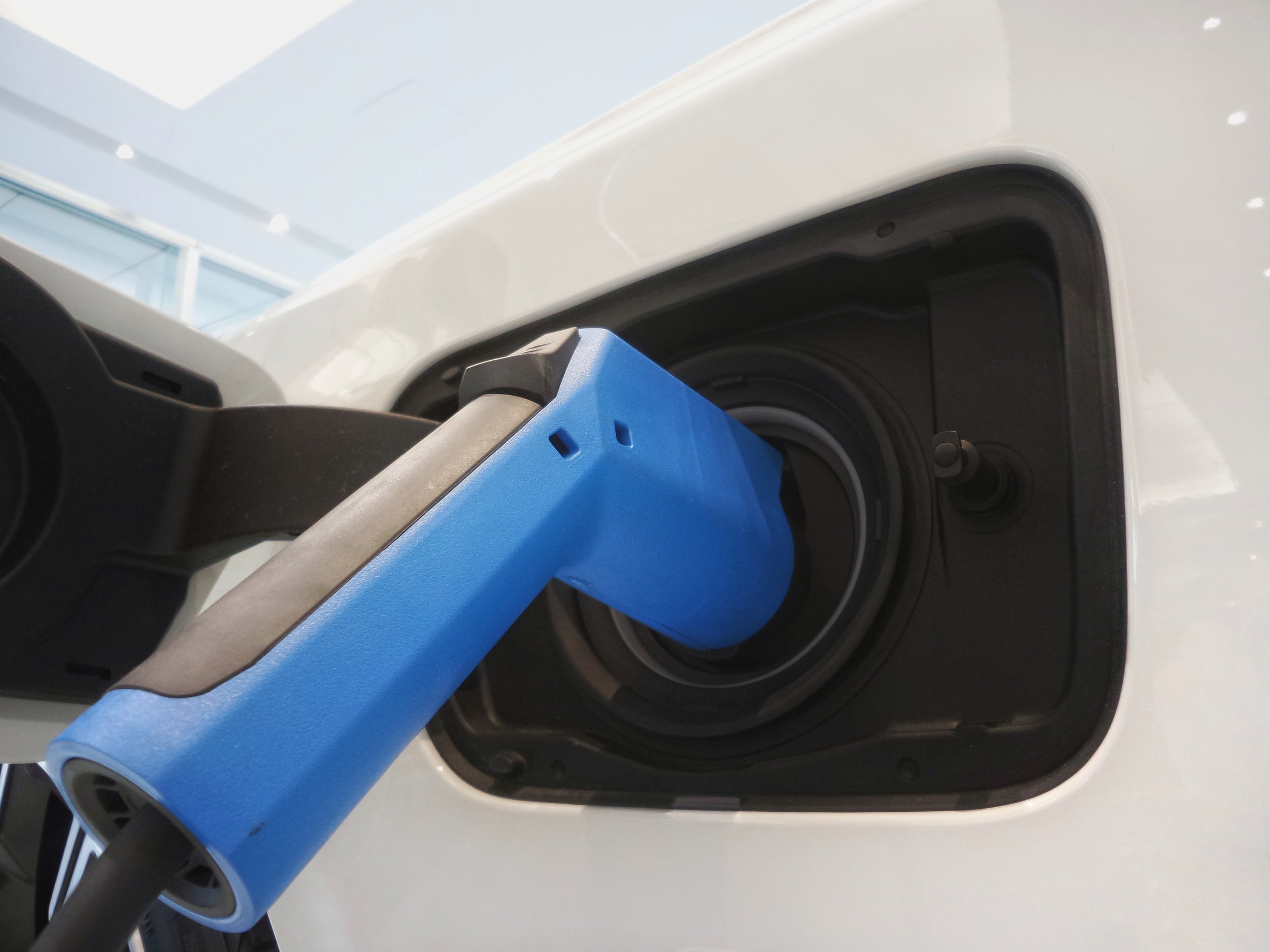
Electricity is a lower emission fuel. Vehicles that use electricity to get around are called electric vehicles, or just EVs. EVs use batteries to store electricity and power electric motors. Some types of EVs, called battery electric vehicles, do not directly emit greenhouse gases or other air pollutants while they drive.
However, EVs are not entirely emissions free. Manufacturing EVs and their batteries can produce greenhouse gas emissions. Generating electricity to charge those EVs can also produce emissions.
But even when we factor in emissions from manufacturing and charging, over the lifetime of an EV, it will produce less greenhouse gas emissions than a comparable gasoline or diesel vehicle. (See how Oregon is reducing electricity emissions on the Cleaner Electricity Grid page)
As Oregon’s electric utilities work to achieve Oregon’s 2040 clean energy targets, driving an EV will produce even fewer emissions over time. See the Oregon Department of Energy’s 2025 Biennial Zero Emissions Vehicle Report for more information on electric and hydrogen vehicles.
Other lower emission fuels, like natural gas, renewable diesel, propane and hydrogen, are used in engines that power transit, school buses, and freight trucks. Engines using those fuels produce less greenhouse gas emissions than the predominantly fossil fuels they replace. Vehicles powered by fuel cells utilizing clean hydrogen produce zero tailpipe emissions.
Other vehicles can benefit from engines that use lower emission fuels. Examples include boats, trains, airplanes, and vehicles used in construction, agriculture, warehouses, and freight yards. Some technology is further along than others, but more options are commercially available every year.
Technology to improve fuel efficiency
It will take several years for electric vehicles and other lower emission fuels to become common on Oregon’s roads, especially in larger vehicles like long-haul freight trucks. We can bridge that gap with technology to make gas and diesel engines more efficient. In the meantime, vehicle manufacturers are working to make gasoline and diesel engines more efficient, and meet federal Corporate Average Fuel Economy standards.
More efficient gas and diesel engines use less fuel when they travel, which produces fewer greenhouse gas emissions.
Fuel efficiency is measured in “fuel economy” or miles per gallon for gas and diesel-powered vehicles. For electric and other alternative fuel vehicles, we use “gallon-equivalent” measurements.
The more miles per gallon a vehicle gets, the more efficient it is, the less fuel it uses, and the less emissions it produces. As a rule of thumb, the fuel efficiency of an average passenger vehicle is doubled when converted to hybrid and doubled again when fully electric, in “gallon equivalent” MPGe.
Hybrid vehicles are an example of using technology to make a gas engine more efficient. Hybrids have a gas engine and a small electric motor and battery. The electric motor assists the gas engine when the car drives, reducing the amount of gas it uses. The battery can be recharged via the car’s brakes, or in some vehicles, can be plugged into a wall outlet or public charging station.
Vehicle regulations and fuel efficiency standards for automakers can only be established by the federal government and California. California standards are typically more rigorous, and Oregon has chosen to adopt California’s standards.

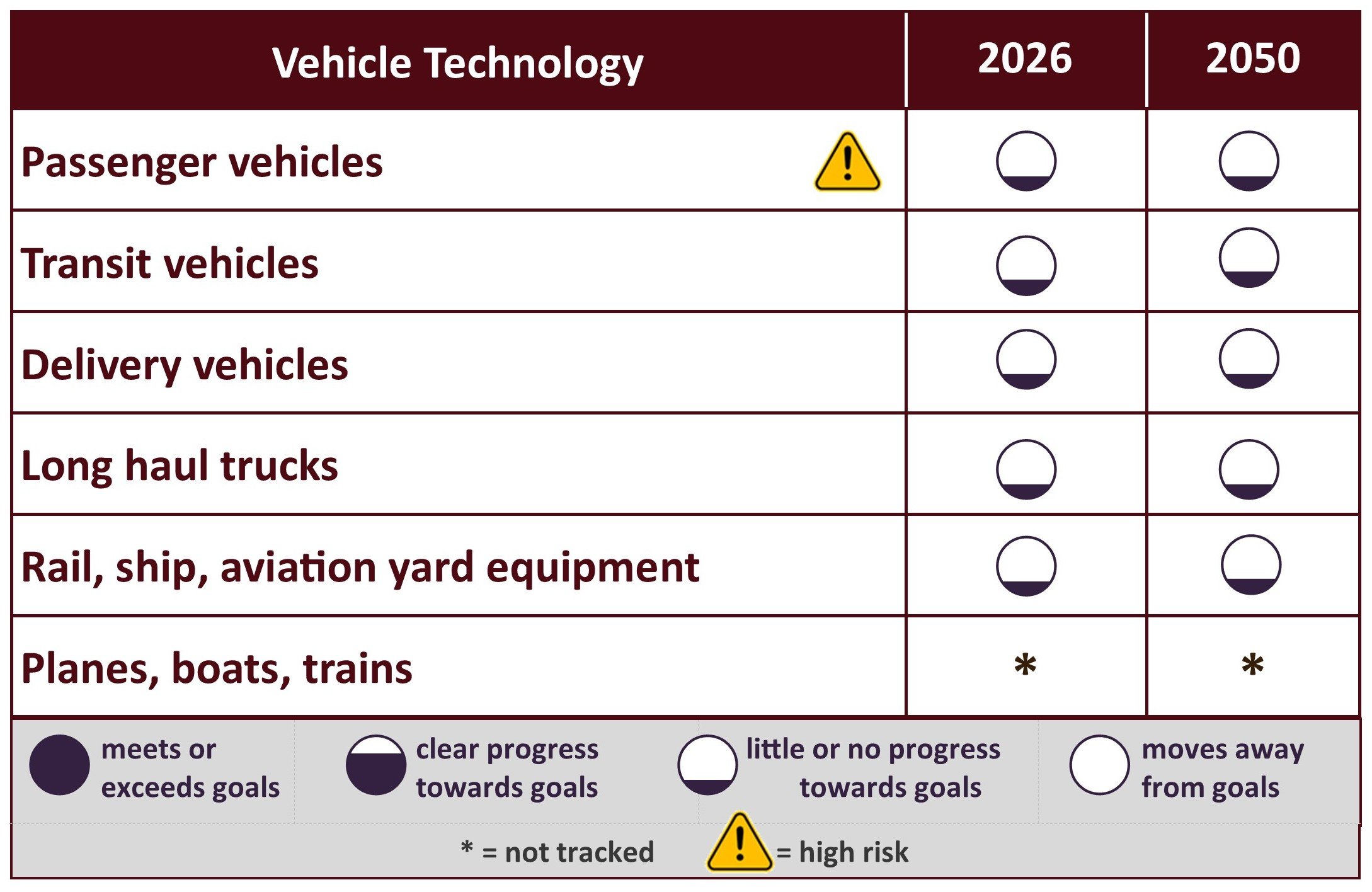
Progress snapshot
Passenger vehicles
This action is identified as a high risk area that represents reversed progress from previous cycles. Legal uncertainty regarding Oregon’s clean vehicle regulations will slow EV adoption.
In 2022 Oregon passed regulations that required all new passenger vehicles sales to be 100% zero emission in 2035. Oregon now expects a significant slowdown in the pace of electric passenger vehicle adoption across the state. Recent federal decisions in 2025 ended federal tax credits for buying a new or used EV and automaker fines for violating federal fuel economy standards. More significant are the recent moves by federal lawmakers to undo environmental protections that allow Oregon and other states to implement stronger vehicle emission standards for cars and trucks.
This has created legal uncertainty around Oregon's authority to regulate vehicle sales using tools like the Advanced Clean Cars II regulation. Oregon, along with a coalition of nine other states, is challenging the change to environmental protections in federal court. If the federal action is upheld, Oregon will not be able to implement and enforce the Advanced Clean Cars II regulation. These federal decisions will slow the transition to electric and lower emission vehicles in Oregon.
Transit and delivery vehicles
Oregon is already seeing electric transit, car service, and delivery vehicles on our streets. However, these and other types of medium- and heavy-duty vehicles face complicated technology, fueling, and cost challenges in transitioning to electric. The 2021 Advanced Clean Trucks rule helps advance state use of zero emission medium- and heavy-duty vehicles. However, this rule is currently under legal challenge.
Long haul trucks
Long haul freight trucks remain one of the most challenging vehicles to decarbonize. EVs fueled by electricity and hydrogen are being tested. Commercially viable vehicle models and sufficient refueling stations along freight corridors are key to driving adoption. Renewable diesel is the popular alternative until these paths are more solid.
The 2021 Advanced Clean Trucks rule, which helps advance state use of zero emission medium- and heavy-duty vehicles, is currently under legal challenge.
Other off-road vehicles (rail, ship, aviation yard equipment, and planes, boats and trains)
Oregon doesn’t have metrics for planes, boats, and trains, but these vehicles produce over 20% of Oregon’s greenhouse gas emissions. State agencies would need to work with our partners across the state to advance ways to reduce emissions from these vehicles.
Explore each category below for an in-depth breakdown of our progress.