
Emissions Reduction Progress
Progress forecasts: 2018, 2022 and 2026
Oregon state agencies monitor progress towards the goal to reduce emissions from transportation to 80% below 1990 levels by 2050. They gather data and analyze current laws, policies, trends and markets to answer: If conditions stayed as they are now, what would Oregon’s emissions levels be by 2050?
In 2018, emissions forecasts said Oregon would reach about 15-20% emissions reduction below 1990 levels for cars, trucks and SUVs. Larger vehicles were not part of that forecast.
In response, state government directed more funding to climate-friendly programs, revised policies, and adopted aggressive new regulations on vehicles and fuels. The federal government created new funding, programs and policies as well.
Those actions paid off. In 2022, the forecast said Oregon would reach about a 60% emissions reduction below 1990 levels. This forecast also included larger vehicles like buses, delivery vans and long-haul freight trucks.
The most recent forecast, using current available data and information, revealed a significant setback. If current conditions continue, Oregon will only reach about 10% emissions reduction below 1990 levels by 2050.
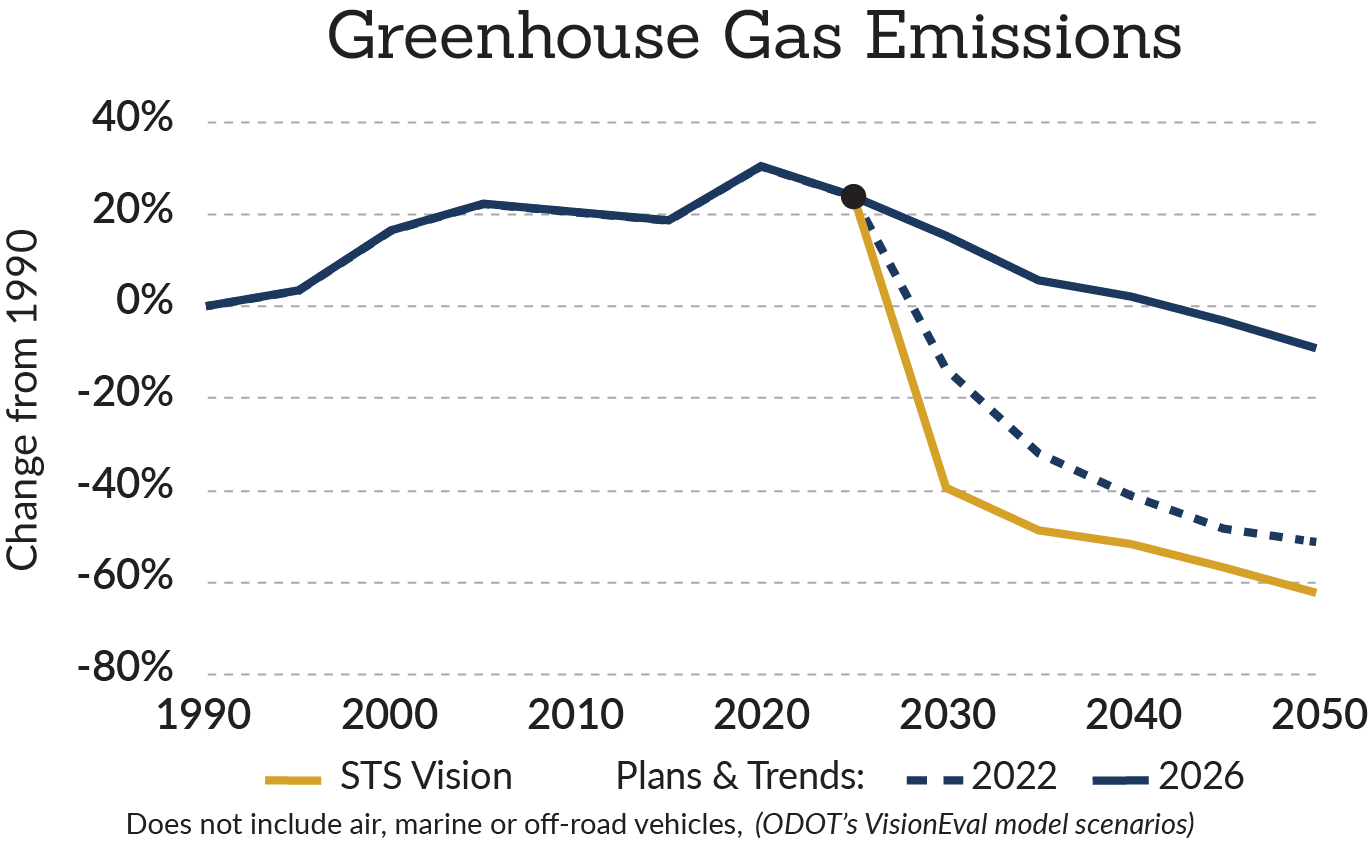
What stalled our progress in the 2026 forecast
In 2024, public policy, market forces and consumers were aligned on an electric future. Federal and state regulations were pushing automakers to offer attractive EV options, people in Oregon were buying them with encouragement from incentives and investments in public EV chargers, and state policies mandated clean electricity generation.
That progress and Oregon’s outlook stalled in 2025 due to a combination of federal government actions, a lack of sustainable transportation funding, and market factors. The forces that affect transportation are complex and interconnected.
Recent federal government actions
Oregon now expects a significant slowdown in the pace of electric passenger vehicle adoption across the state relative to prior forecasts. Recent federal decisions ended federal tax credits for buying a new or used EVs, future funding for electric vehicle charging and automaker fines for violating federal fuel economy standards.
More significant are the recent moves by federal lawmakers to undo environmental protections that allow Oregon and other states to implement stronger vehicle emission standards for cars and trucks. This has created legal uncertainty around Oregon's authority to regulate vehicle sales using tools like the Advanced Clean Cars II regulation. Oregon’s 2022 Advanced Clean Cars II regulation requires all new passenger cars, trucks and SUVs sold in Oregon to be zero emission by 2035. Oregon, along with a coalition of nine other states, is challenging the change to environmental protections in federal court. If the federal action is upheld, Oregon will not be able to implement and enforce the Advanced Clean Cars II regulation. These federal decisions will slow the transition to electric and lower emission vehicles in Oregon.
Read the Vehicle Technology and Fuel Technology pages for more details.
Lack of sustainable transportation funding and pricing
The Oregon Legislature increased state fuel tax rates incrementally between 2017-2024, but the highest inflation in decades has reduced purchasing power. Federal fuel taxes have also not changed in 30 years, and there have been no new gas taxes levied in several years in Oregon’s cities and counties. As a result, gas tax revenues are not sustainable and will continue to fall short of costs to maintain Oregon’s multimodal transportation system.
Road usage charging, where drivers pay their fair share for using roads, can help recover that revenue and since it incentivizes people to drive less, is the most climate-supportive approach. In 2025, the Oregon Legislature passed a law that mandated enrollment in OReGO, the state’s road usage charging program, for electric and hybrid vehicles starting in 2027, the second state to do so. This mandate ensures highly efficient vehicles will contribute their fair share to maintaining our multimodal transportation system. However, the 2025 law did not change the OReGO per mile rates. Portland-area tolling programs have also been paused. That means the state still lacks sustainable transportation funding.
Transit providers are also struggling with rising costs, labor shortages and funding shortfalls. Despite an infusion of federal funding from the 2021 Infrastructure Investment and Jobs Act, urban transit faces an uncertain future. The state’s dedicated funding stream for transit, a payroll tax, is not keeping up with future costs and inflation. Transit service is expected to be reduced in communities across the state unless funding is increased. Without sustainable, long-term funding, low-emission modes like public transit, biking, walking and rolling are not making further progress.
Read the Pricing, Funding and Markets pages and Transit Service page for more details.
Market factors
Market factors include business and individual actions. Given fewer federal incentives and regulations, U.S. automakers are retreating from the EV market. They are canceling models, delaying next-generation vehicles, and reverting EV plants to producing gasoline vehicles instead. A California analysis attributes half the drop of EV sales in 2025-2026 to the limited supply of EVs by automakers, and the other half to the end of federal tax credits for buying a new or used EVs.
Gas prices also play a significant role in shifting consumer demand to cleaner cars and modes of travel. While official forecasts of energy prices remain low, the volatility is high. As a result, when gas prices spike, fewer vehicle choices and transit options will be available to meet consumer demand.
Consumer choices also include how far and how often people drive, and impact fuel efficiency and emissions of vehicles. Larger vehicles like SUVs and pickup trucks continue to be popular; and that share is growing. People in Oregon also keep their vehicles an average of 13 - 14 years, which is longer than other state averages. This slows the transition to lower emission vehicles.
Read the Passenger Vehicle page for more details.
Progress to reduce growth in vehicle miles traveled and clean up each vehicle mile driven
We split our work to reduce emissions into two broad objectives: Reduce growth in vehicle miles traveled, and clean up each vehicle mile. We track progress in both objectives and that informs our actions in each category.
Two objectives
Reduce growth in vehicle miles traveled
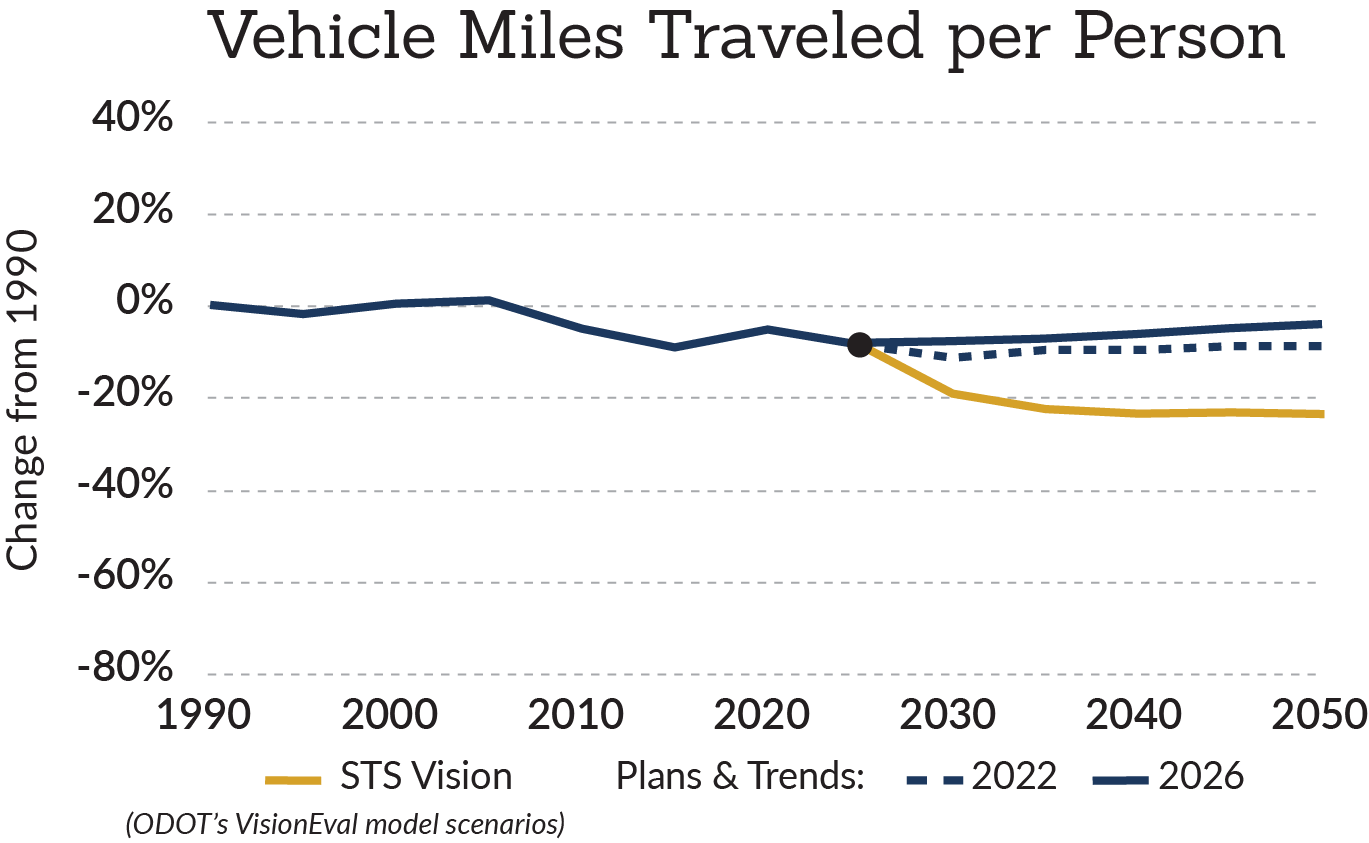
Reduce growth in vehicle miles traveled
Current trends suggest that Oregonian’s driving habits won’t change much through 2050. State laws, like our pioneering work to shift from gas taxes to road usage fees, and state planning rules that enable changing investment priorities and reviewing major road projects, will help with small reductions over time.
However, the lack of sustainable funding, especially for transit, limits progress on encouraging alternatives to driving. State agencies can reduce how far and how often people drive by investing in affordable low-emission transit, bike, walk and roll options. They can also restructure how people pay for transportation so more revenue flows to efficient, safe infrastructure through a user-pays approach -- drive less, pay less.
Visit the pages on Land Use; Transportation Options; System Operations; and Pricing, Funding and Markets to learn more about ways to improve.
Clean up each vehicle mile
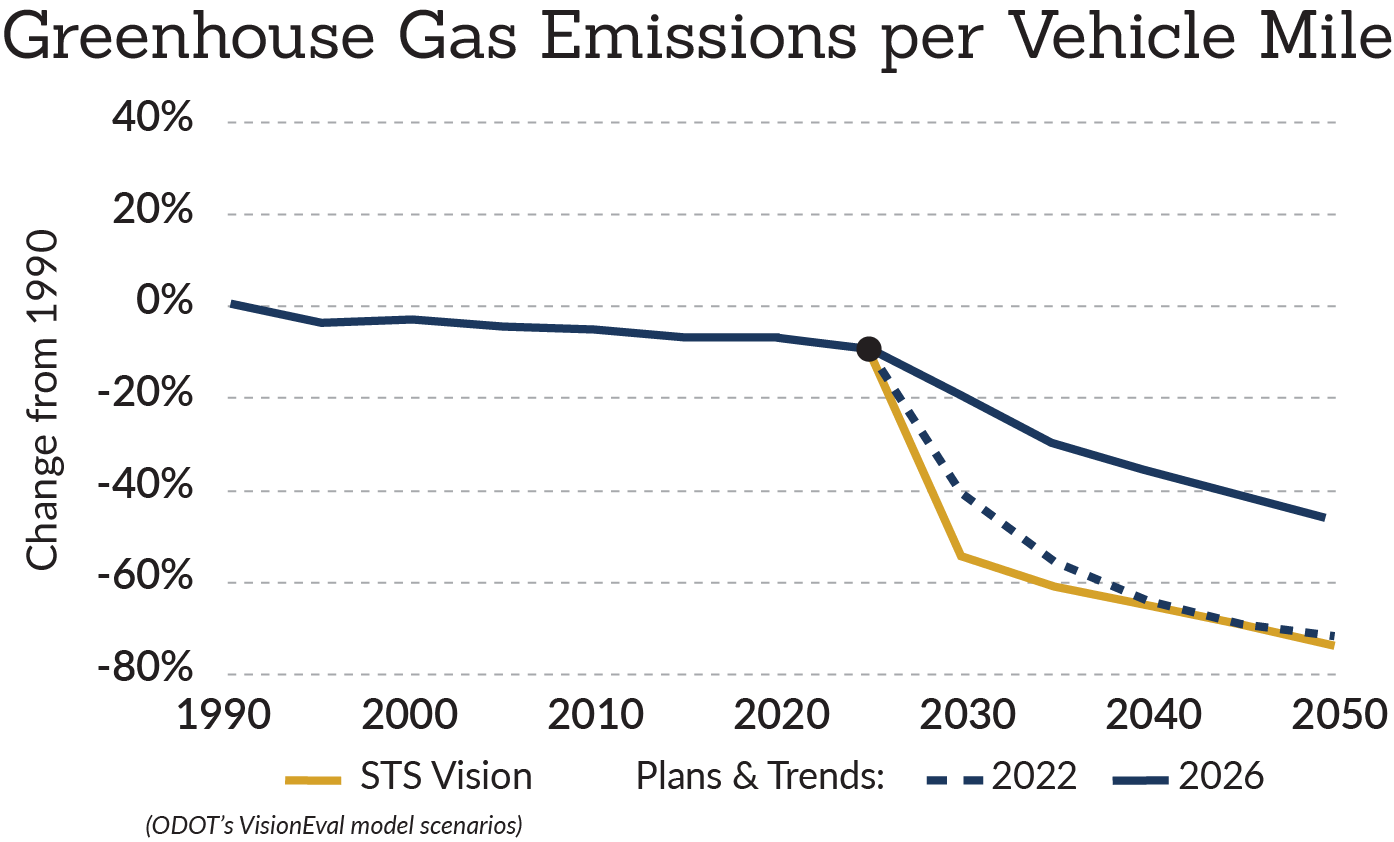
Clean up each vehicle mile
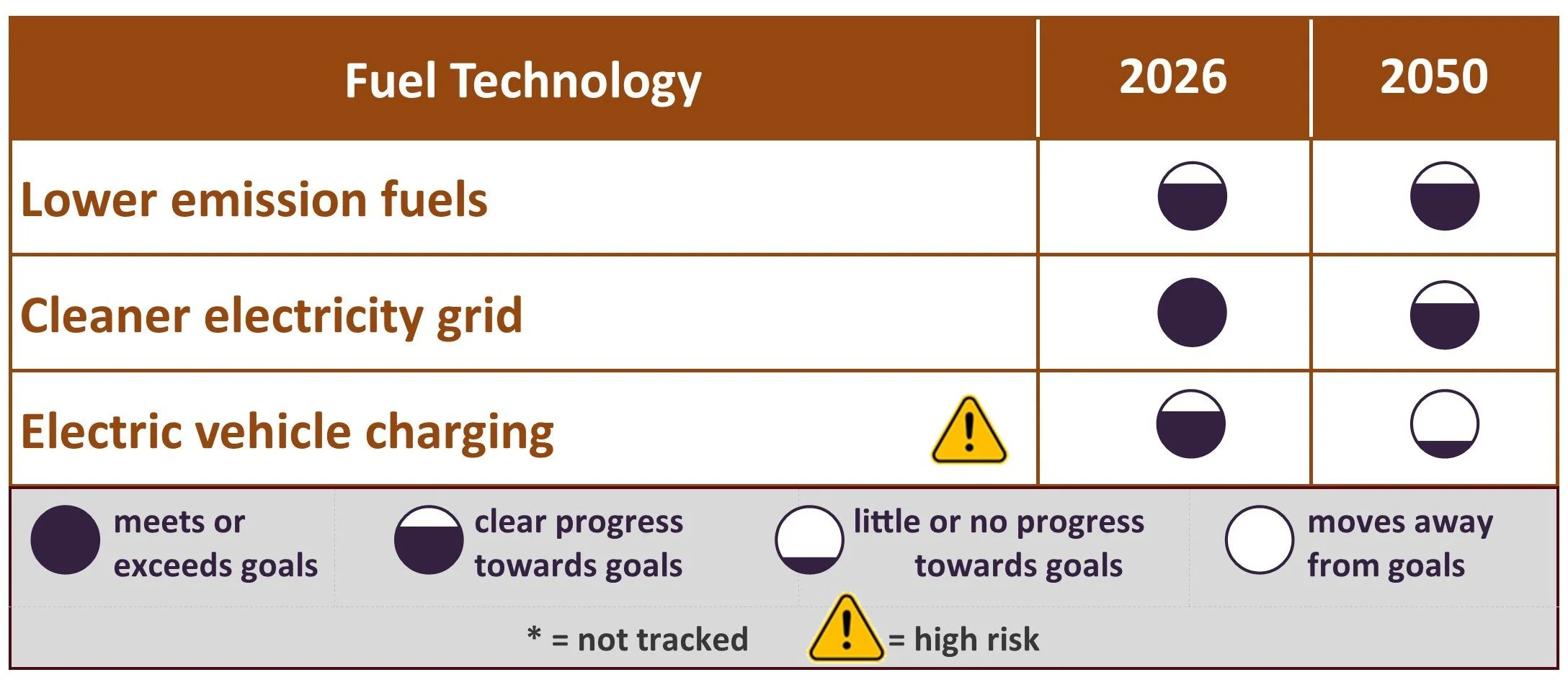
Oregon’s strong progress in the last few years to drive cleaner vehicles is facing significant setbacks. It will be challenging to restore momentum in this objective. Oregon may need to pursue a different path if federal clean vehicle regulations do not withstand legal challenges, and federal funding of EV tax credits and public EV charging stations is not replaced.
However, Oregon’s Clean Fuels Program and Clean Electricity laws remain intact. They will need to shoulder more of the work to reduce emissions. State agencies can also work together to ensure new vehicles – passenger, transit, delivery and long haul trucks -- use low emission fuels and have enough places to charge and fuel up.
Learn more about opportunities to improve this objective on the Vehicle Technology, Fuel Technology, and System Operations pages.
Category progress
Learn more about progress in each category:
Visit the About page to learn how the categories fit in with the 2050 goal and objectives.
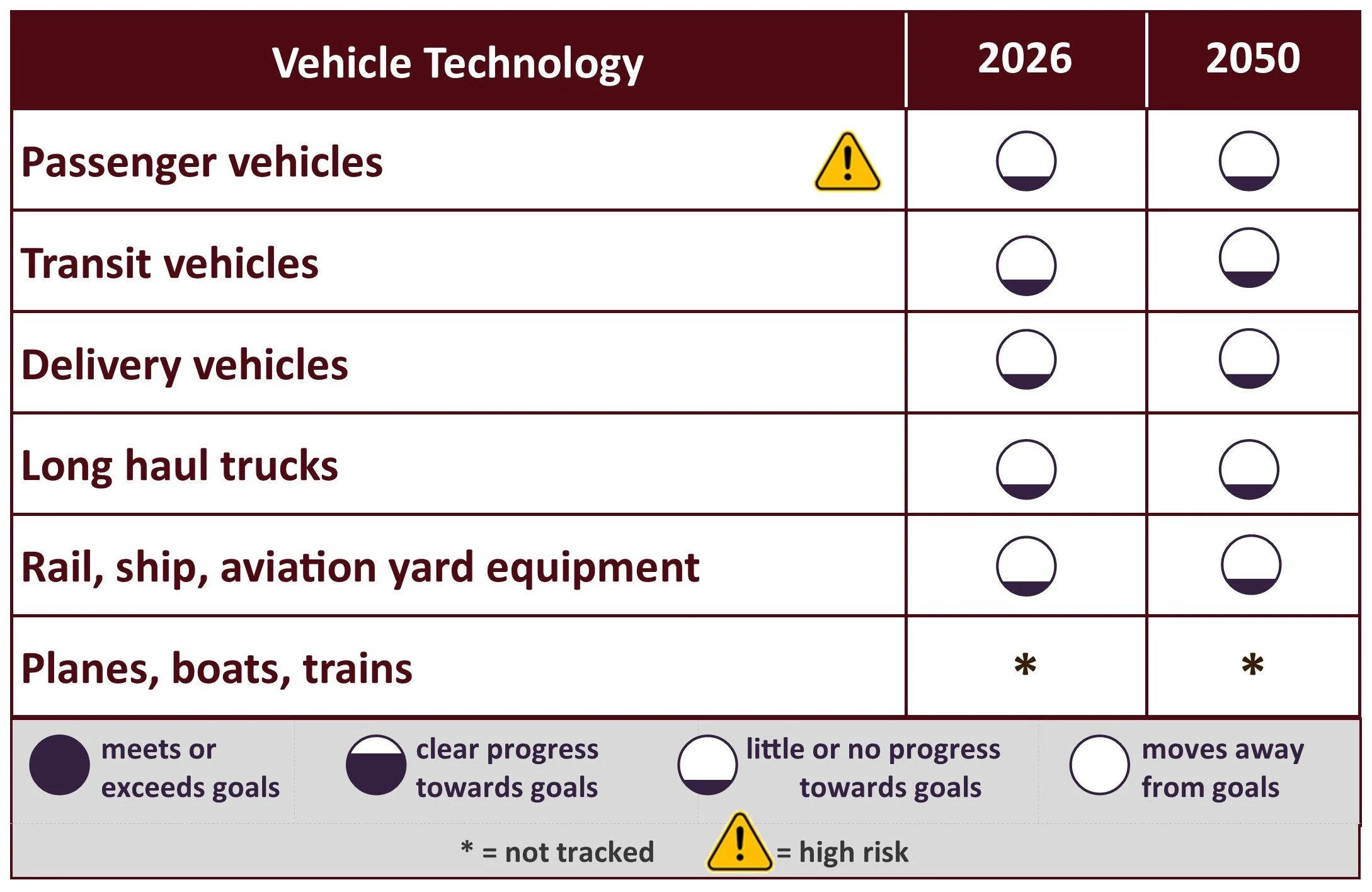
Prior progress stalled
Our 2026 monitoring forecast identified four High Risk areas. These areas have reversed progress from last monitoring cycle.

High Risk Areas
Passenger Vehicles: Legal uncertainty regarding Oregon’s clean vehicle regulations will slow EV adoption.
EV Charging: The loss of sustained funding for public EV chargers may slow EV adoption.
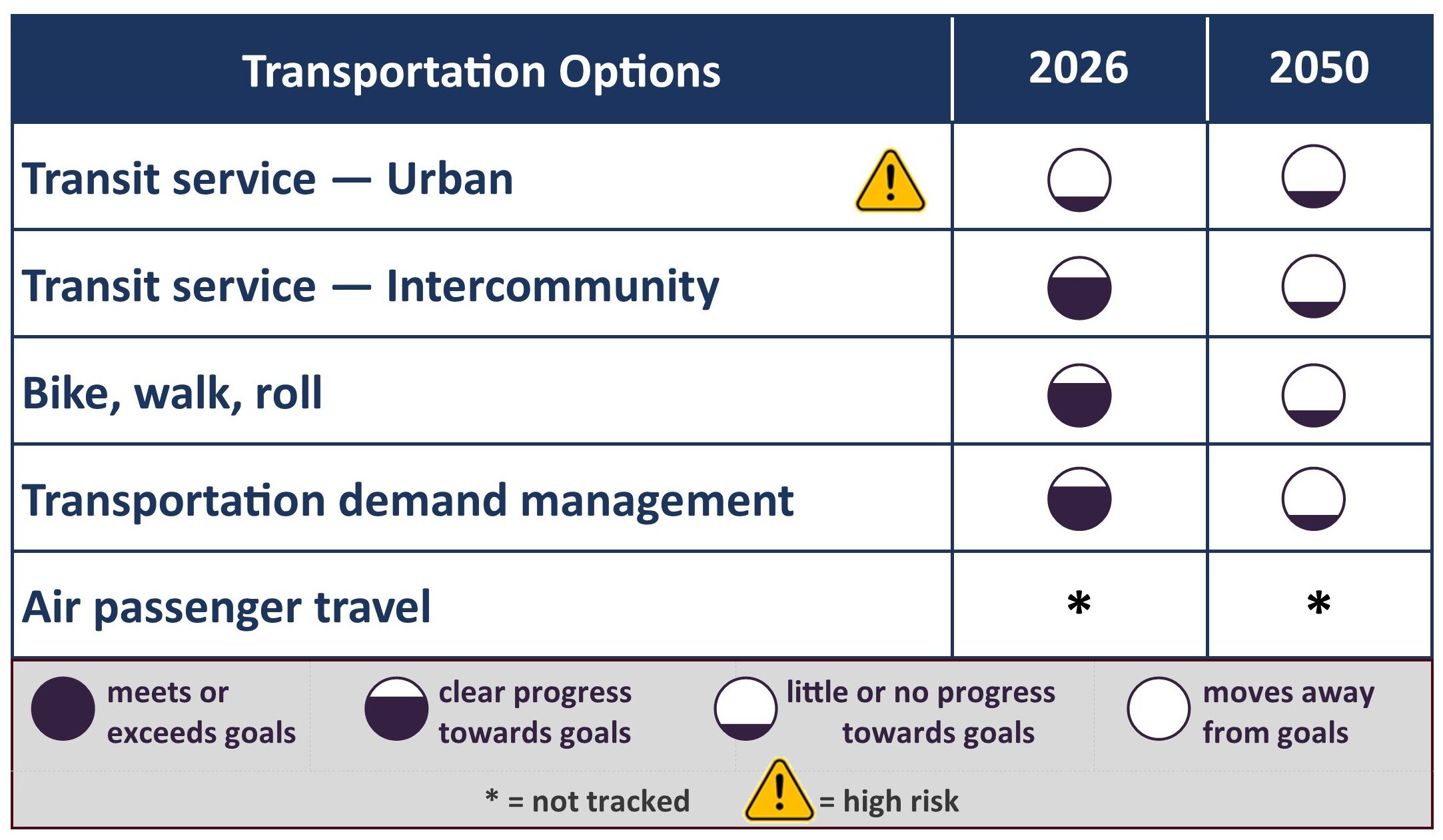
Transit Funding: Transit service is expected to be reduced in communities across the state unless funding is increased.
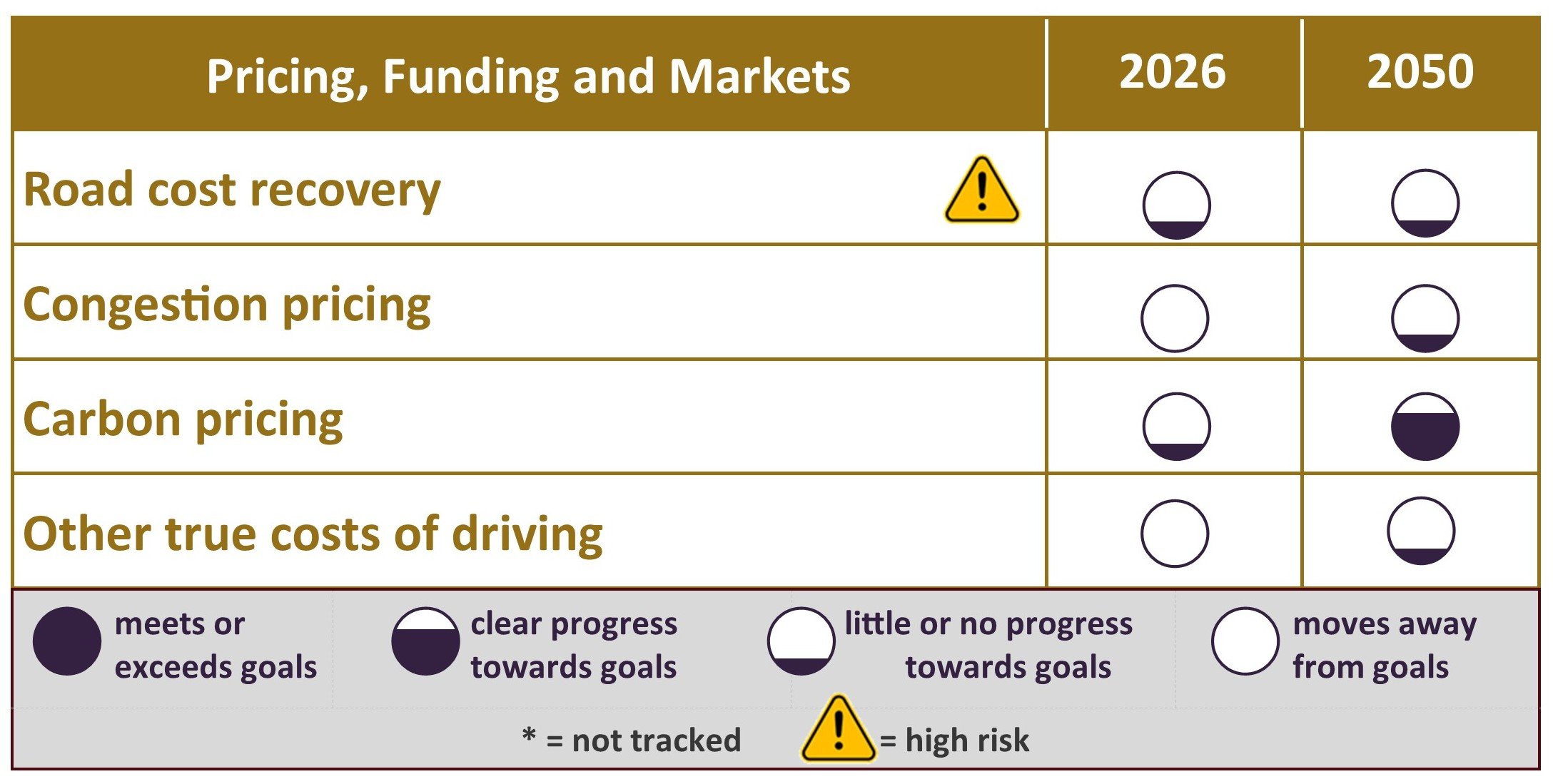
Sustainable Funding and Pricing: Oregon lacks sustainable, long-term funding to maintain our transportation system and low-emission modes. A stronger shift to paying the full cost of road usage would provide a price signal for reducing vehicle miles traveled.
Restoring progress towards our 80% reduction goal
Additional action across all six categories is needed to get back on track towards 80% emissions reduction by 2050. Potential actions Oregon can take include:
Vehicle Technology
To counter the severe setback of federal changes, Oregon is working with other states to reassert clean vehicle regulations and identify other best practices that could be implemented at the state level to partially fill the gap created by the federal rollbacks.
Support targeted state and federal EV incentive programs like the Oregon Clean Vehicle Rebate program, similar rebates for commercial fleets, and the federal tax credit on EV purchases.
Fuel Technology
Provide more and stable funding for existing public charging and private on-site fleet charging programs.
Complete DEQ’s rulemaking to extend the Clean Fuels program out to at least 2040.
Implement recommendations from the Oregon Energy Strategy, which highlights use of low-carbon fuels in sectors that are hard to electrify.
Pricing, Funding and Markets
Expand Oregon’s road usage charging program, OReGO, to ensure all vehicle types are paying their fair share.
Build on OReGO and the gas tax to ensure stable, long-term revenue for maintaining Oregon’s multimodal transportation system.
Support private insurance companies in raising enrollment in pay as you drive options for drivers in Oregon.
System Operations
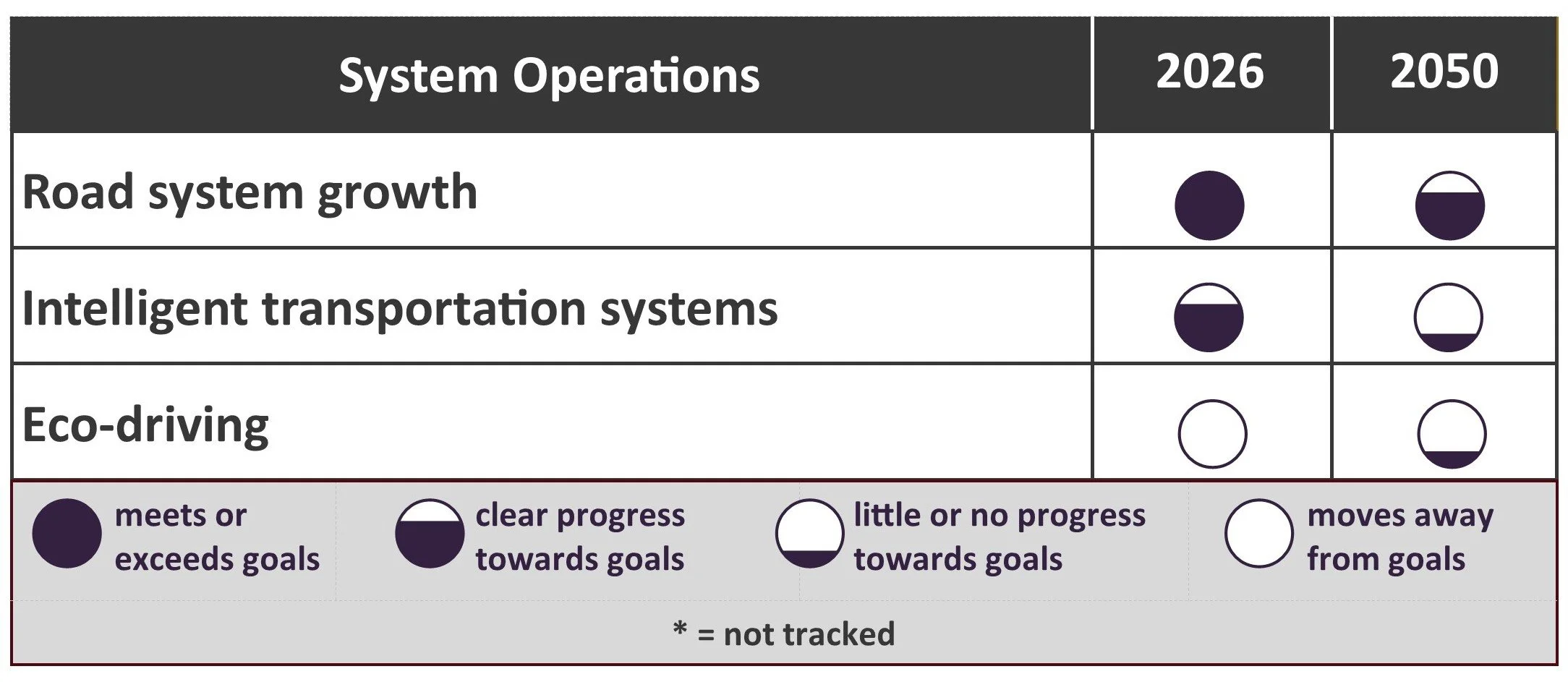
Limit road growth to strategic expansions to match population growth, alleviate severe congestion and bottlenecks, improve safety and reduce crashes.
Follow existing state policy to exhaust other options before expanding capacity, and control for induced demand on road projects.
Provide funding to maintain existing Intelligent Transportation Systems like traffic cameras, smart signals and variable speed signs that help to reduce congestion and emissions.
Transportation Options
Increase investment in transit service to keep pace with inflation and Oregon’s population.
Dedicate more funding to complete walking and biking infrastructure projects that will close gaps to form a connected and safe system.
Provide funding and resources to manage demand on the transportation system and encourage people to use public transit, biking, walking and rolling.
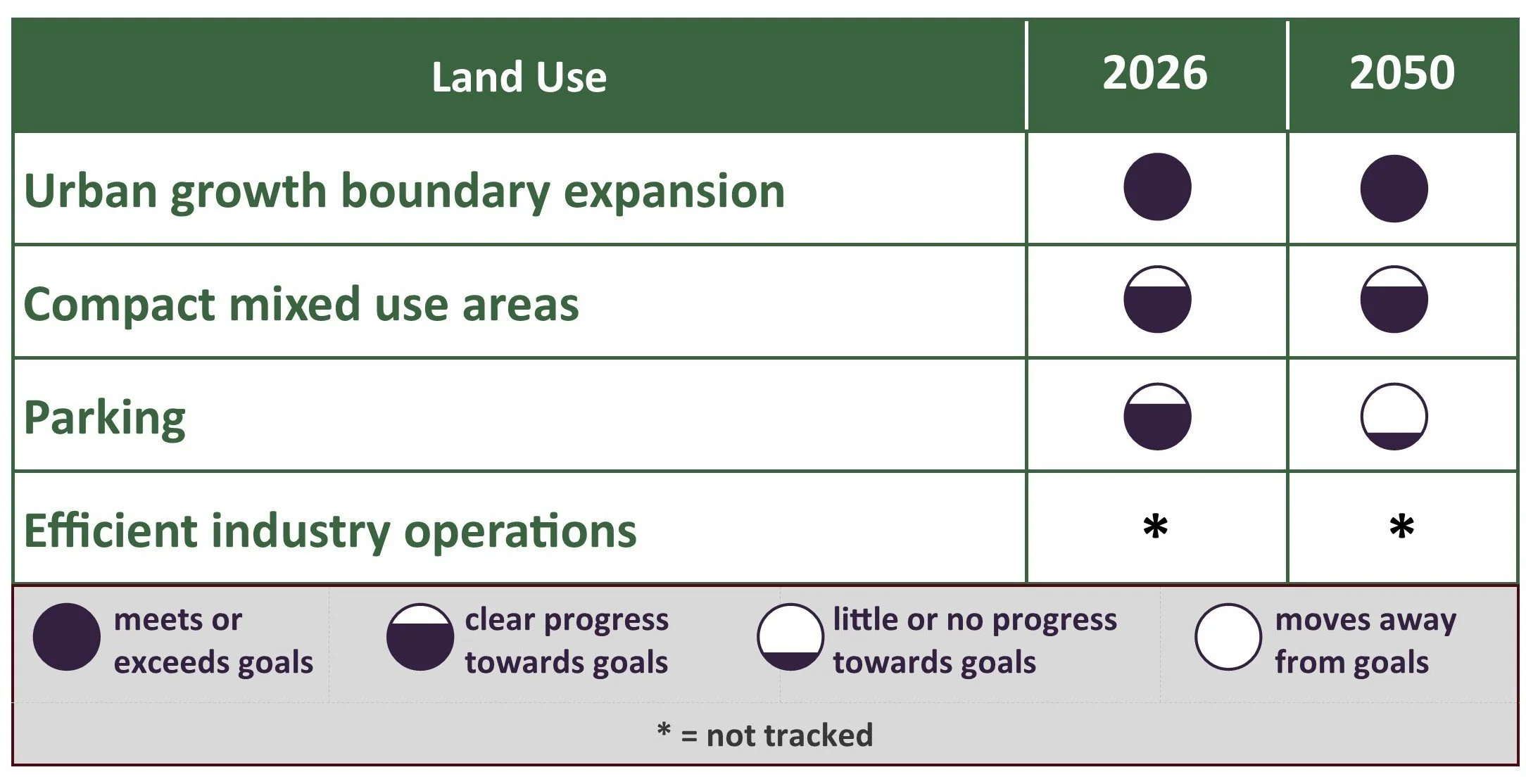
Land Use
Continue to apply the state land use planning system to accommodate future growth in Oregon’s population.
Develop tools to help cities identify strategic areas for investment to revitalize neighborhoods and other areas through affordable housing and transportation infrastructure investments.
-
2021 and 2022 were critical years for emissions reduction in Oregon. New rules and regulations adopted by the departments of Environmental Quality and of Energy promised to reduce emissions from vehicle fuels and clean up each mile driven. Some of these programs and policies are still in effect, while others are facing challenges.
The Advanced Clean Trucks rule required an increasing percentage of truck sales in Oregon to have zero tailpipe emissions; 40% - 75% of sales by 2035, depending on truck size.
The Clean Fuels Program expansion rule required Oregon fuel providers to significantly reduce emissions from fuels through 2035. These changes will result in almost 50% reduction in tailpipe greenhouse gas emissions.
The Advanced Clean Cars II rule required all new passenger cars, trucks and SUVs sold in Oregon to be zero tailpipe emissions by 2035.
Clean Energy Targets required reduced electricity-related emissions for the two largest Oregon electricity utilities, meaning nearly all electricity used in Oregon will be emissions-free by 2040.
The 2022 forecast also included factors that are largely out of the state’s control, like:
Vehicle manufacturer plans to shift production to electric and other low emission vehicles.
Updates to federal CAFE regulations.
Updates to Oregon population growth and income forecasts.
Other state agency policies that began development in 2022 will have an impact through 2050:
Changes to Oregon Transportation Planning rules, which will require larger cities to plan for “climate friendly areas” with increased density, mixed use, and multimodal transportation options.
A big increase in funding to active transportation and transit projects in ODOT’s 2024-2027 project budget allocation — $255 million over three years — which was nearly double the money from the previous three-year budget cycle.
ODOT committed $100 million over five years to build out more public EV charging infrastructure along major roads and in Oregon’ communities.
See the About page for more about the creation of our Vision, the Statewide Transportation Strategy and how we track progress.