Transit Service: Urban and Intercommunity
Urban transit services include buses and passenger rail that operates in and around cities.
Intercommunity transit provides transportation between communities and connects local transit networks across the state. These buses and trains link people to jobs, healthcare, social or sports events, recreation sites, airports, and many other areas critical to daily life. The more seamless those connections are, the better.
Urban and intercommunity transit services share a common benefit: Every person riding on a bus or passenger rail means fewer cars on the road for those trips, which reduces greenhouse gas emissions.
Those emission reductions can be even larger if the transit vehicle is powered by a low-emission fuel, like electricity or renewable diesel. (See the Vehicle Technology page for more information)
Maintaining a reliable and safe urban transit experience for travelers is necessary to convince people to use the system, and to create positive experiences for people who use it as their mode of choice. While transit in Portland, Salem, and Eugene currently provide about 90% of total statewide urban and intercommunity transit trips, smaller urban areas also rely on transit services.
Transit is also important for Oregon’s growing population of older adults, and for people who take transit to work every day. Low-cost transit options are critical to make sure all individuals are able to utilize the transportation system, especially as driving costs continue to rise. Transit can also help to support healthy lifestyles and social cohesion within our communities.
Transit service: Emissions reduction vision
Urban Transit
By 2050, transit service route miles per capita will have increased three to five fold from today in the state’s largest urban areas to accommodate ridership from a growing population.
By 2050, a majority of urban households have access to public transit options close to their home.
Urban transportation options are made possible by established and reliable funding sources like the Statewide Transportation Improvement Fund through 2050.
Intercommunity Transit
By 2050, intercommunity transit service miles have doubled along major roads and highways, and expands to selected new routes.
Amtrak Cascades in Oregon will improve reliability and increase service to accommodate Oregon’s growing population, following state and federal investments through 2050.
High speed rail services will stretch from Vancouver, British Columbia to Seattle, Washington to Portland, Oregon.
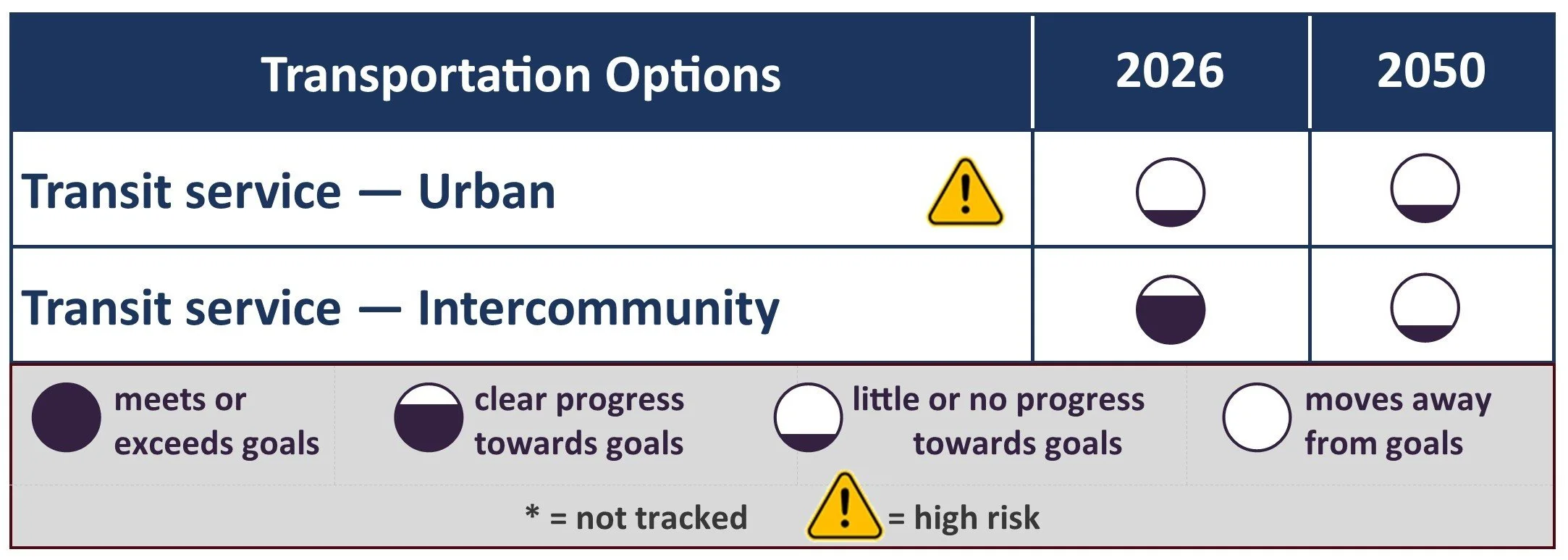
How Oregon is doing
This action is identified as a high risk area that represents reversal of progress from previous cycles. Transit service is expected to be reduced in communities across the state unless funding is increased.
Urban transit struggles
Urban transit service ridership has been recovering following the COVID-19 pandemic; as of 2026 transit ridership is roughly 70% of pre-pandemic levels, with fewer commuters using transit passes. This may represent a “new normal” of ridership numbers. Transit ridership has rebounded among older adults, people with disabilities, and tourists.
Transit providers are also struggling with rising costs, labor shortages and funding shortfalls. Despite an infusion of federal funding from the 2021 Infrastructure Investment and Jobs Act, urban transit faces uncertainty in the future:
Fewer riders means less fare revenue.
The state’s dedicated funding stream for transit, a payroll tax, may not keep up with future costs and inflation.
Overall, statewide transit service is forecast to barely keep up with Oregon’s population growth through 2050.
Gains in intercommunity transit
Intercommunity transit ridership increased in the first half of the 2020s.
The Amtrak Cascades in Oregon saw record ridership in 2023-24, supported in part by added service in 2023. Amtrak Cascades is working on improving reliability between Portland and Eugene. A new, modern and fuel-efficient generation of trains will debut in the Amtrak Cascades fleet in 2026.
The states of Washington and Oregon are partnering with British Columbia to study how high-speed rail might serve as a catalyst for a stronger, connected economic region in the Cascadia Megaregion. The Cascadia High-Speed Rail study envisions a route stretching from Vancouver, British Columbia to Seattle, Washington to Portland, Oregon.
Oregon’s intercommunity bus service, POINT, has improved service and opened new routes over that same timeframe.
New transit planning rules
New transportation planning requirements for Oregon’s eight largest metropolitan areas require cities and counties to plan for priority transit routes and safe access to key destinations like schools, healthcare, and shopping using transit. This includes monitoring access to quality transit service, and safe and convenient pedestrian crossings near transit stops.
As ridership in Oregon recovers, the Oregon Department of Transportation will continue to track transit performance across the state, including in large and small urban areas, and intercommunity services.
How Oregon can improve
The influx of state and federal funding that allowed Oregon to make good progress on transit goals in the past few years needs to be renewed. We’ll need steady federal, state and local investments in transit to: Keep pace with Oregon’s growing population and inflation; sustain urban service; keep popular passenger trains on time; improve rail service; and adapt to meet changes in commuting patterns.
ODOT will pursue passenger rail grant opportunities as they become available. The Oregon Passenger Rail Service Development Plan is ODOT’s approach to improving and expanding intercity passenger service between Eugene and Portland over the next 20 years.
State agencies and local transit agencies can continue to make it easier for people to transfer between locally provided urban transit services and intercommunity services. Specifically:
Use new technology to provide real-time bus/train arrival and departure information.
Ensure connecting bus services coordinate bus schedules.
Confer with freight railroads hosting passenger trains and work to keep trains on time.
Improve transit reliability in congested urban areas by creating more bus lanes, expanding bus-on-shoulder pilot programs, and prioritizing traffic signal timing and lanes for transit vehicles.
Improve rider experience through payment options, more fare options for underserved communities, and increased safety for all riders.
Provide state matching funds for federal rail grant opportunities to improve reliability and service.
Continue planning for Cascadia High-Speed Rail service between Portland and Vancouver, B.C.
Making progress on other strategies can also help:
Transit agencies can switch bus fleets to electric or lower emission fuels. (See the Vehicle Technology and Fuel Technology pages)
Land use policies can help ensure new homes, businesses and other destinations are well served by transit. (See the Land Use pages)
Improvements to walking, rolling and biking can help ensure those active modes are easy and safe ways to access transit. (See the Bike, Walk, Roll page)